
GDC explains earned state-prison timing on its Performance Incentive Credit page.
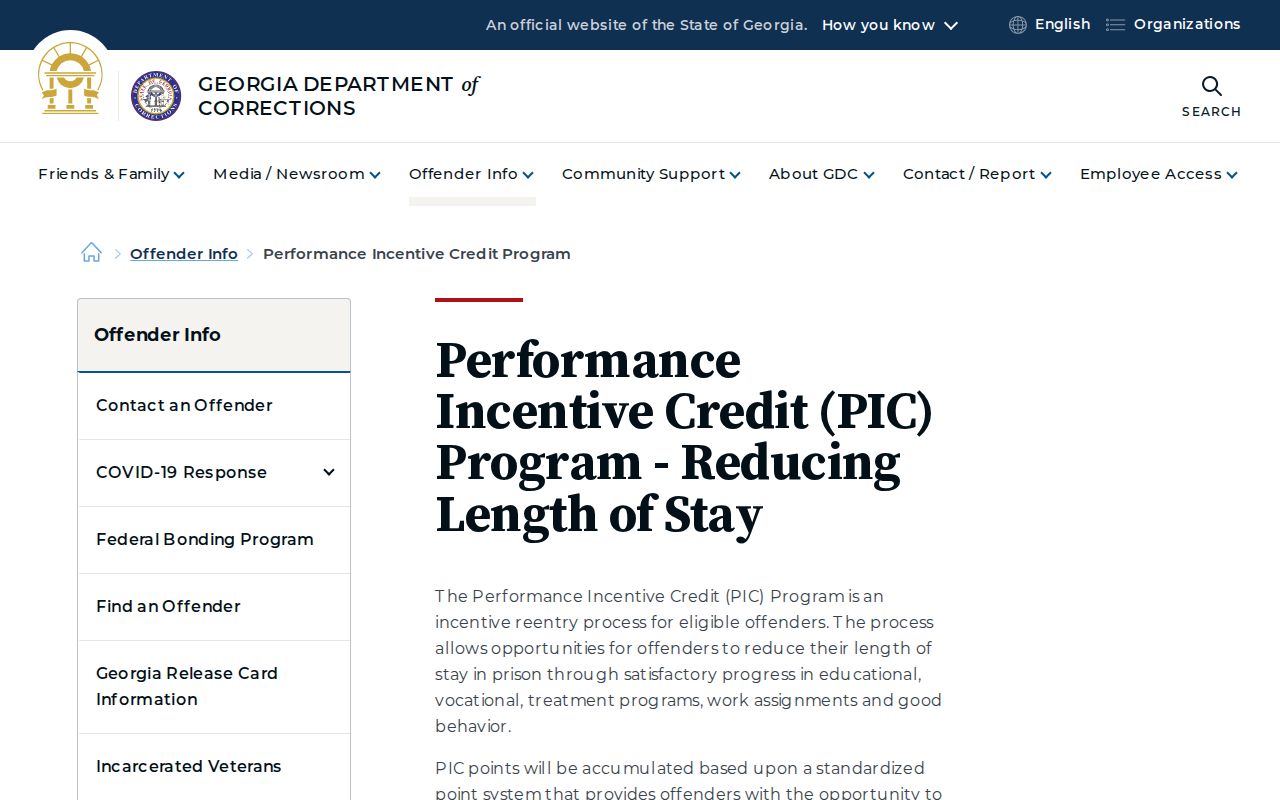
The program can affect an eligible person's TPM or maximum release date, but it does not establish an actual discharge by itself.
Georgia State Release Records
GDC manages sentenced state offenders, not the ordinary pretrial and short-term population of Hart County Jail. A person transferred from Hart County to state custody leaves the local roster, but that local change is not a community release. The statewide offender query becomes the next official source. It can place the person at a GDC facility and provide the release-date context described by the department.
A true state-prison release may lead to parole supervision, probation on a split sentence, sentence discharge, or another hold. The public record must be read with the Parole Board and court record when those systems control the next step.
Find a Hart County State Offender
GDC offers a “Find an Offender” landing page and a direct offender query. The department describes its public tool as a way to find an offender currently in a GDC facility. Its family-information guidance also says the tool can provide charges, location, and release date. Because public coverage and status can change after discharge, a missing result is not proof that no state record exists.
- Open the direct GDC offender query.
- Search by GDC ID when known because it is more precise than a name.
- Otherwise enter the full name and narrow possible matches with available identity fields.
- Open the matching result and compare charges, facility, photograph, and identifier.
- Read every date label exactly; do not turn a maximum date or tentative date into an actual release.
- Use the Parole Board lookup if the record points to parole, and request written GDC verification when necessary.
The Hart County release-record guide explains when to return to the sheriff or court instead. County and state records may describe different stages of the same case.
GDC Search Fields and Meaning
Search results should be matched as a set, not by one familiar name. GDC warns that photographs display automatically when available, so users should expect an image on some records. A photo is an identification aid, not proof of current custody or present legal status.
| Field | How to use it |
|---|---|
| GDC identifier | Distinguishes the state-offender record from similar names. |
| Name and identity details | Help confirm the correct person. |
| Charges | Describe the state record but do not replace the court judgment. |
| Facility location | Shows the GDC placement reported by the system. |
| Release date | Must be read with its exact status and label. |
| Photograph | May appear automatically when available. |
If identity or timing remains uncertain, GDC instructs users to verify information in writing through Inmate Records and Information.
Georgia Corrections Records Contact
The research provides a central written-verification address rather than a Hart County GDC office. Use it for the state record, not for a county-jail booking or Hart County bond document.
Georgia Department of Corrections
Inmate Records and Information
PO Box 1529
Forsyth, GA 31029
Online source
GDC Find an Offender and direct offender query
Statewide sentenced-offender records
Include the person's full name, GDC number if known, date of birth or other permitted identifier, and the specific fact that needs verification. Ask whether the date is projected, maximum, tentative, actual release, or another field. A focused request is easier to answer than a broad demand for every record.
Projected Date Versus Discharge
A date in a state correctional record does not always mean the person left prison on that day. Georgia sources distinguish a maximum release date, a tentative parole month, and an actual release decision. The Parole Board says a tentative parole month, or TPM, is the month for final review and is not a final promise of release.
A TPM may be postponed or cancelled because of misconduct or failure to complete required programming. Sentence corrections, new cases, detainers, and Board review can also affect timing. For that reason, record the field label and the date together. Confirm actual release through the final GDC or parole record instead of repeating the date without context.
Note: Parole eligibility and a tentative parole month do not guarantee a state-prison release date.
Performance Incentive Credit
GDC's Performance Incentive Credit program can affect state-prison timing for eligible offenders. The department says eligible participants can accumulate up to 12 points in case-plan, education or vocational, and work-detail categories. Those points may reduce either a tentative parole month or maximum release date by one to twelve months.
O.C.G.A. § 42-5-101 authorizes work incentive credits tied to academic or vocational achievement, work assignments, and behavior. GDC reports credits to the Parole Board, which may consider them in final parole decisions. This is a state-prison framework. The research found no public Hart County Jail formula that should be substituted for it.
Georgia Sentence Restrictions
Georgia release timing is offense and sentence specific. It should not be reduced to a generic 85-percent claim. The Parole Board says many parole-eligible offenders become eligible after one-third of the sentence, while eligibility does not guarantee release. O.C.G.A. § 42-9-45 supplies general eligibility rules and special timing for some sentences.
For non-life sentences for serious violent felonies committed on or after January 1, 1995, Board guidance says the person must serve 100 percent of the prison term imposed. O.C.G.A. § 17-10-6.1 governs serious violent offender restrictions. Other exclusions include life without parole and death sentences. The judgment, offense date, and statute control the individual calculation.
Parole After GDC Custody
When release is by parole, GDC custody and Board supervision records answer different questions. Before release, the TPM lookup may show the tentative review month. After release, the Board's parolee database can help verify parole status. Georgia DCS coordinates field supervision, and Hart County is served by the Elberton Field Office.
A parole record should not be described as probation. Parole follows release from a prison sentence by Board authority. Probation is imposed by a court, either instead of confinement or as part of a split sentence. A person may also reach the maximum release date without parole. Read the disposition and supervision source together.
County Jail Versus State Prison
The Hart County inmate search covers active local jail custody and links to VINELink. It does not replace the statewide GDC query after a prison transfer. Conversely, the GDC portal is not the right first source for a person who only had a county booking and never entered state custody.
| Record question | Correct source |
|---|---|
| Was the person released from Hart County Jail? | Sheriff, jail, VINE, and court |
| Did GDC receive the sentenced person? | GDC offender query |
| What is the state release-date field? | GDC record and written verification |
| Was parole granted? | Georgia State Board of Pardons and Paroles |
| What did the sentencing judge order? | Court record |
This separation prevents a transfer from being mislabeled as freedom from custody and keeps local release details attached to the proper custodian.
Verify a GDC Release in Writing
GDC directs users to verify public offender information through Inmate Records and Information. A written inquiry helps when an online record no longer appears, a release label is unclear, or a date conflicts with the judgment. Identify the offender by GDC number and state the exact fact needing confirmation.
Ask whether the date is a maximum release date, projected date, actual release date, or another field. For time computation, GDC guidance says the incarcerated person may need to contact a counselor and possibly the county clerk. The Clerk verifies the filed sentence but does not administer GDC credits or parole decisions.
Keep the response with the query result and access date. An amended sentence, detainer, disciplinary action, or program credit can explain different snapshots. The field's creator is best placed to clarify it.
State Discharge and Local Records
A GDC discharge does not erase earlier Hart County records. The Sheriff's booking and transfer entries remain local, while the court judgment remains judicial. GDC reports state confinement. If parole followed, the Board and DCS add supervision.
Build the sequence. Start with the county booking only if one occurred, follow the transfer, preserve the GDC identifier, read the release field, and check supervision only when supported. This separates county release, state discharge, and supervision discharge.
GDC Photos and Identity Checks
GDC warns that offender photographs display automatically when available. That image can help distinguish people with similar names, but it is not a Hart County booking photograph and does not establish current custody by itself. Match the GDC number, identity fields, charges, location, status, and date labels together.
If the public query shows no photograph, continue with identifiers rather than rejecting the record. If it shows a photograph, do not infer the image date or facility unless the page states it. For a Hart County booking image, the Sheriff's records channel remains the relevant source, subject to Georgia booking-photo restrictions.