
The Board publishes agency events through its official events calendar.
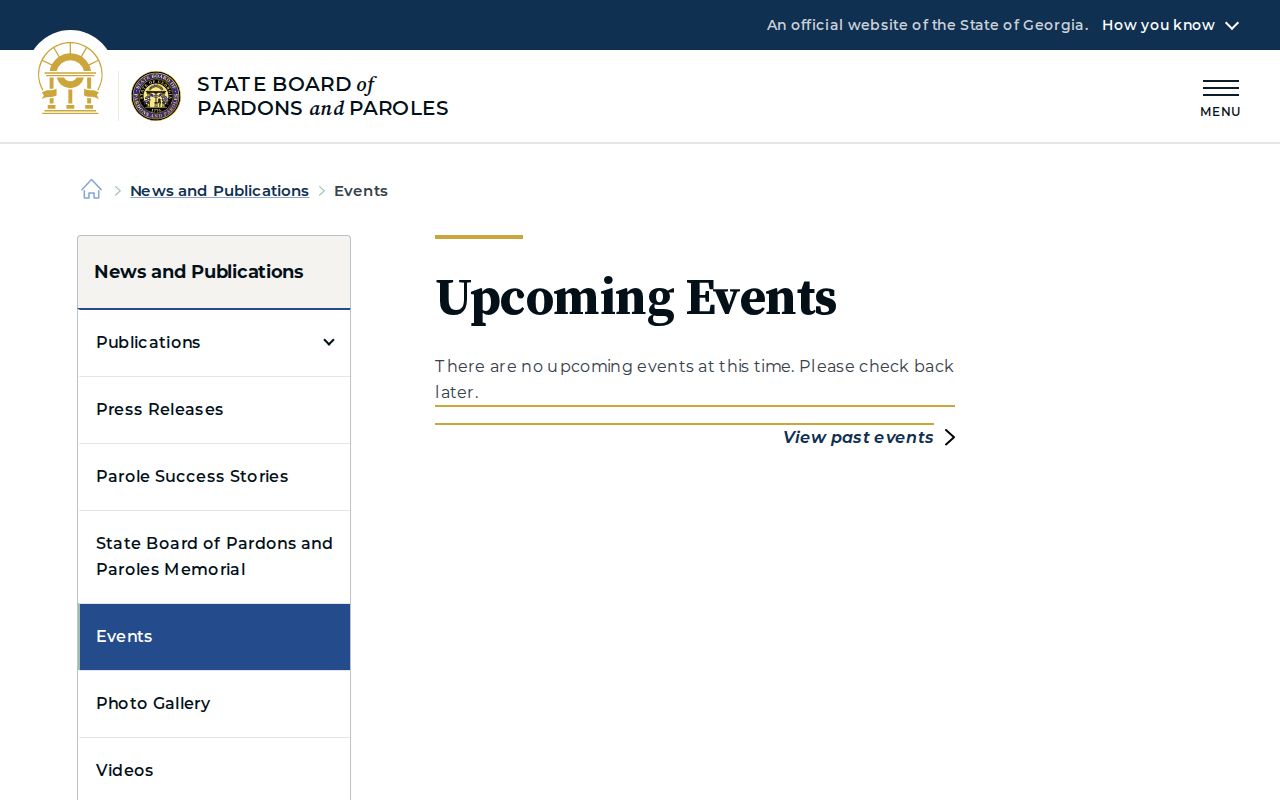
The calendar covers public Board events, not individual offender-case hearings or parole decisions.
Georgia Parole Review Path
The Board makes statewide parole decisions for eligible Georgia prison inmates. Hart County may be the county of conviction, future residence, or supervision area, but it is not the decision-making venue. Parole consideration is administrative and automatic for eligible prisoners under O.C.G.A. § 42-9-45; no formal application is required.
The record path changes with time. Before release, use GDC to confirm the person and the TPM lookup to check tentative Board timing. After release, use the parolee database to verify parole status. Court probation is different and should be checked through the judgment and Georgia Department of Community Supervision.
Find a Tentative Parole Month
The Board's TPM resource explains the meaning of a tentative parole month and links to the direct lookup. A TPM is the month in which final review is completed and, if appropriate, a parole release date is set. It is not the release date itself.
- Confirm the person and GDC identifier in the statewide offender query.
- Open the Board's TPM information page.
- Continue to the direct TPM lookup and enter the identifying information.
- Match the result carefully to the GDC record.
- Record the status label with the month and do not call it a grant.
- Check again near final review because a TPM can change.
The Hart County release search shows how to move back to county, court, or GDC records when parole is not the applicable path.
Parole Outcomes and Terms
Board records use terms that describe stages rather than one simple hearing result. A clear reading distinguishes review, decision, and actual release.
| Term | Meaning |
|---|---|
| TPM set | A tentative month for final review, not a guaranteed release. |
| Parole denied | The Board did not approve parole at that review. |
| Final review | The Board considers whether to set a release date. |
| TPM postponed or cancelled | Timing changed, including for misconduct or unmet programming. |
| Released to parole | The person left prison subject to parole supervision. |
| Life-sentence decision | A grant or denial subject to special reconsideration rules. |
Program or work-release completion can be a condition before parole where required. GDC placement in a program is not itself proof of release.
Parole Board Calendar Limits
The Board maintains an official events calendar and has described monthly public meetings. Those meetings concern policy and operations. The Board expressly states that offender cases are not considered and parole decisions are not made at the monthly public meetings.
When the calendar was checked on July 15, 2026, it showed no upcoming events and offered access to past events. That calendar status can change, but it does not become an individual case-hearing schedule. A reader seeking one person's outcome should use TPM and parolee records, not infer a decision from attendance at a public meeting.
Note: A public Board meeting is not an offender-case hearing and does not announce individual parole decisions.
Georgia Parole Eligibility
O.C.G.A. § 42-9-45 provides general eligibility timing and automatic consideration. Board guidance says many parole-eligible inmates become eligible after one-third of the prison sentence, but eligibility never guarantees release. The statute includes special rules for long aggregate sentences and other categories.
Non-life sentences for serious violent felonies committed on or after January 1, 1995 are subject to the 100-percent prison-term rule described by the Board and O.C.G.A. § 17-10-6.1. Life without parole and death sentences are not parole eligible. Fourth-felony recidivist rules and life-sentence cases also require special treatment. The offense, date, judgment, and applicable statute control.
Why a TPM Can Change
The Board says misconduct or failure to complete required programming can postpone or cancel a TPM. GDC's Performance Incentive Credit program can move eligible timing in the other direction. Eligible offenders may earn up to 12 points, potentially reducing a TPM or maximum release date by one to twelve months.
Sentence corrections, new charges, detainers, or Board reconsideration can also affect the path. This is why a projected month must be checked again and why VINE notification is useful near an expected status change. A custody alert still does not explain the Board's reasoning or the court disposition.
Verify Parole After Release
After a person leaves GDC on parole, the Board's Parolee Search is the more relevant public record. Search by the available identity information and compare the result with the GDC record. The parolee database addresses parole status, while DCS handles field supervision.
- Confirm the state offender identity and release context in GDC.
- Search the official Board parolee database.
- Match the person by identifier and available identity details.
- Read supervision status and dates as labeled.
- Contact DCS for field-office instructions, reporting, or local supervision questions.
Hart County is served through the DCS Elberton Field Office at 233 N Oliver Street, Elberton, GA 30635. The office serves Elbert, Franklin, Hart, Madison, Oglethorpe, and the Northern Circuit.
Hart County Parole Contacts
The decision source and supervision source are separate. The State Board controls parole review and its lookup systems. DCS provides the Hart County field-office connection after release.
Georgia State Board of Pardons and Paroles
Official TPM lookup, parolee search, and events calendar
Statewide parole decision authority
DCS Elberton Field Office
233 N Oliver Street
Elberton, GA 30635
(706) 213-2032
Monday-Friday, 8:00 a.m.-4:30 p.m.
Do not send a parole decision question to Hart County Jail once state custody and Board jurisdiction are established. The jail can document its own transfer, while GDC, the Board, and DCS document later stages.
Hart County Parole Record Timeline
A full parole timeline begins with the sentencing judgment, continues through GDC reception, and then reaches Board review. If parole is granted, the GDC release event and parolee database mark the move to community supervision. DCS then becomes the practical Hart County contact through Elberton.
Keep each date with its source and label. A sentencing date, eligibility date, tentative parole month, release date, and supervision discharge date describe different events. Substituting one for another creates a false timeline. Ask the agency controlling that stage to verify conflicts.
Georgia's Victim Information Program may provide state-prison or parole release notice to registered victims. The published VIP number is 1-800-593-9474. Notification is an alert, while Board and GDC records remain the sources for the decision and custody history.
Check Final Parole Release
Near an expected TPM, return to Board and GDC sources rather than assuming the month stayed unchanged. Confirm that final review produced a release date, then check whether the person actually left state custody. If the record shows parole, use the parolee search and DCS office. If it shows continued GDC custody, the tentative month did not produce community release then.
A county court cannot certify the Board's final choice. It supplies the judgment that created the sentence. Hart County Jail can document an older local transfer but not a later state-prison release. These limits give each date an authoritative source.
Georgia Parole Case Review
Georgia's process is not a public courtroom hearing where a Hart County visitor watches a case. The Board reviews offender files administratively. Public meetings address policy and operations, and individual cases are not considered there. The events calendar cannot answer when a named person will receive a decision.
The TPM lookup is the correct pre-release path. A set month means the case is positioned for final review, subject to change. A denial means parole was not approved at that review. A postponed or cancelled TPM can follow misconduct or unmet programming. Preserve the displayed term instead of reducing every result to approved or denied.
After parole release, the parolee database becomes more useful than the TPM screen. Match the state identifier and use DCS for Hart County field supervision. If the person reaches a maximum date without parole, do not create a parole record where none exists.
Eligibility Is Not Release
Eligibility is the earliest point for consideration, not a promise of release. O.C.G.A. § 42-9-45 provides general timing and special rules for long sentences. Board guidance says many eligible offenders reach consideration after one-third of the sentence.
Serious violent felony sentences covered by O.C.G.A. § 17-10-6.1 can require the full prison term. Life without parole, death sentences, and other excluded categories differ. Read the offense date and judgment before applying a general rule.
The Board's public calendar may show past or future agency events, but a calendar change does not alter a named offender's TPM. Always return to the offender-specific lookup. When the public events page has no upcoming items, that finding says only that no events were posted at the time checked. It does not mean parole review stopped or that all pending cases were denied.